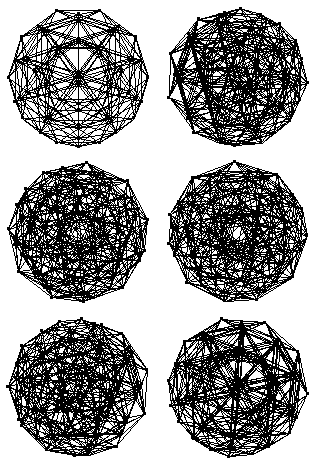
From Photo to String Art
Drop your image here
or click to browse files
Upload any image and watch it transform into a stunning thread-based masterpiece. Perfect for artists, crafters, and anyone who loves unique wall art.
From Photo to String Art
Drop your image here
or click to browse files
Simply drag & drop or select any image from your device. Works with portraits, landscapes, pets, and more
Our advanced algorithm analyzes your image and creates the perfect string art pattern with optimal thread placement
Follow the step-by-step guide to create your physical string art masterpiece with the generated pin sequence.
String art is a geometric art form that creates stunning visual patterns using only threads or strings wrapped around nails or pins placed on a board. This nail and string art technique, also known as pin and thread art, transforms simple materials into complex, beautiful designs through mathematical precision and artistic vision.
Originally developed in the 1960s by mathematician Mary Everest Boole, modern string art has evolved to incorporate advanced continuous line algorithms that optimize thread placement for maximum visual impact. Our string art generator utilizes sophisticated computational methods to analyze your photos and generate precise nail-to-nail sequences, making it accessible for both beginners exploring string art ideas and experienced artists creating professional string art patterns.
Whether you're working with traditional string art kits or creating custom string art designs, this ancient craft combines mathematical precision with artistic expression, resulting in unique wall art that captures light and shadow in remarkable ways.
Primary Qualcomm PM8150 or PM6125 (depending on regional board revision) paired with a sub-PMIC for secondary rails.
Start by learning to identify common components on a live board using the schematic. The schematic will have labels like "VPH_PWR" (main battery voltage) or "VREG_L5A" (a specific regulated voltage). Practice tracing these lines on the schematic and then finding the corresponding test points on the boardview. This builds a strong foundation for more complex troubleshooting.
Never probe components, test for resistance, or solder on a motherboard while the battery or a DC power supply is connected.
Downloading files from unofficial sources carries risks.
: Offers a comprehensive collection of Vivo Hardware Ways, which are simplified visual guides for specific problems like LCD light ways , charging paths , and network solutions in PDF or JPEG formats.
The Vivo U10 utilizes a microUSB 2.0 port housed on a separate sub-board, connected via a flex cable (FPC) to the mainboard. The schematic illustrates the VBUS (5V) line, USB_IN, and the Data Positive (DP) / Data Negative (DN) lines. This section is vital for resolving "fake charging" or "device not recognized" errors. 3. Display and Backlight Section


Primary Qualcomm PM8150 or PM6125 (depending on regional board revision) paired with a sub-PMIC for secondary rails.
Start by learning to identify common components on a live board using the schematic. The schematic will have labels like "VPH_PWR" (main battery voltage) or "VREG_L5A" (a specific regulated voltage). Practice tracing these lines on the schematic and then finding the corresponding test points on the boardview. This builds a strong foundation for more complex troubleshooting.
Never probe components, test for resistance, or solder on a motherboard while the battery or a DC power supply is connected.
Downloading files from unofficial sources carries risks.
: Offers a comprehensive collection of Vivo Hardware Ways, which are simplified visual guides for specific problems like LCD light ways , charging paths , and network solutions in PDF or JPEG formats.
The Vivo U10 utilizes a microUSB 2.0 port housed on a separate sub-board, connected via a flex cable (FPC) to the mainboard. The schematic illustrates the VBUS (5V) line, USB_IN, and the Data Positive (DP) / Data Negative (DN) lines. This section is vital for resolving "fake charging" or "device not recognized" errors. 3. Display and Backlight Section
This string art patterns generator builds upon the pioneering work of the open-source community and mathematical research in computational geometry:
MIT License - This project is open source and available under the MIT License.
Source Code: Available on GitHub Pages with full source transparency
Attribution: When sharing or modifying, please credit StringAr.com and maintain license notices
Commercial Use: Permitted under MIT terms - feel free to use for commercial string art projects
Our enhancements to the original algorithms include: