Alice -cal Vista- -split Scenes- __top__ Today
Version: 2.2.15 (2020-12-05)
Windows 32-bit or 64-bit supported
Version: 2.2.15 (2020-12-05)
Windows 32-bit or 64-bit supported
Added option to auto-relaunch if streaming/encoding pipeline stalls
Added real-time buffering checkbox to "URL" input options
Fragmented MP4 flag changed to "-movflags frag_keyframe+empty_moov" to conform to latest guidance
Added option to write FFmpeg output to weekly rotating logfile
Added menu option to save currently open preset without prompting for filename (i.e. File > Save)
Fixed minor cosmetic bug on main page
Fixed minor cosmetic bug on Encoding Status page
Fixed error with duplicate DirectShow devices
Fixed bug with non-ASCII DirectShow device names
Added textbox to provide custom input commands
Added input decoder read buffer option
Added NVENC presets list
Status display expanded with restart & kill commands
File output selection now includes filename prompt
Improved bitness checking allowing for smaller install footprint
Miscellaneous minor changes
Original release

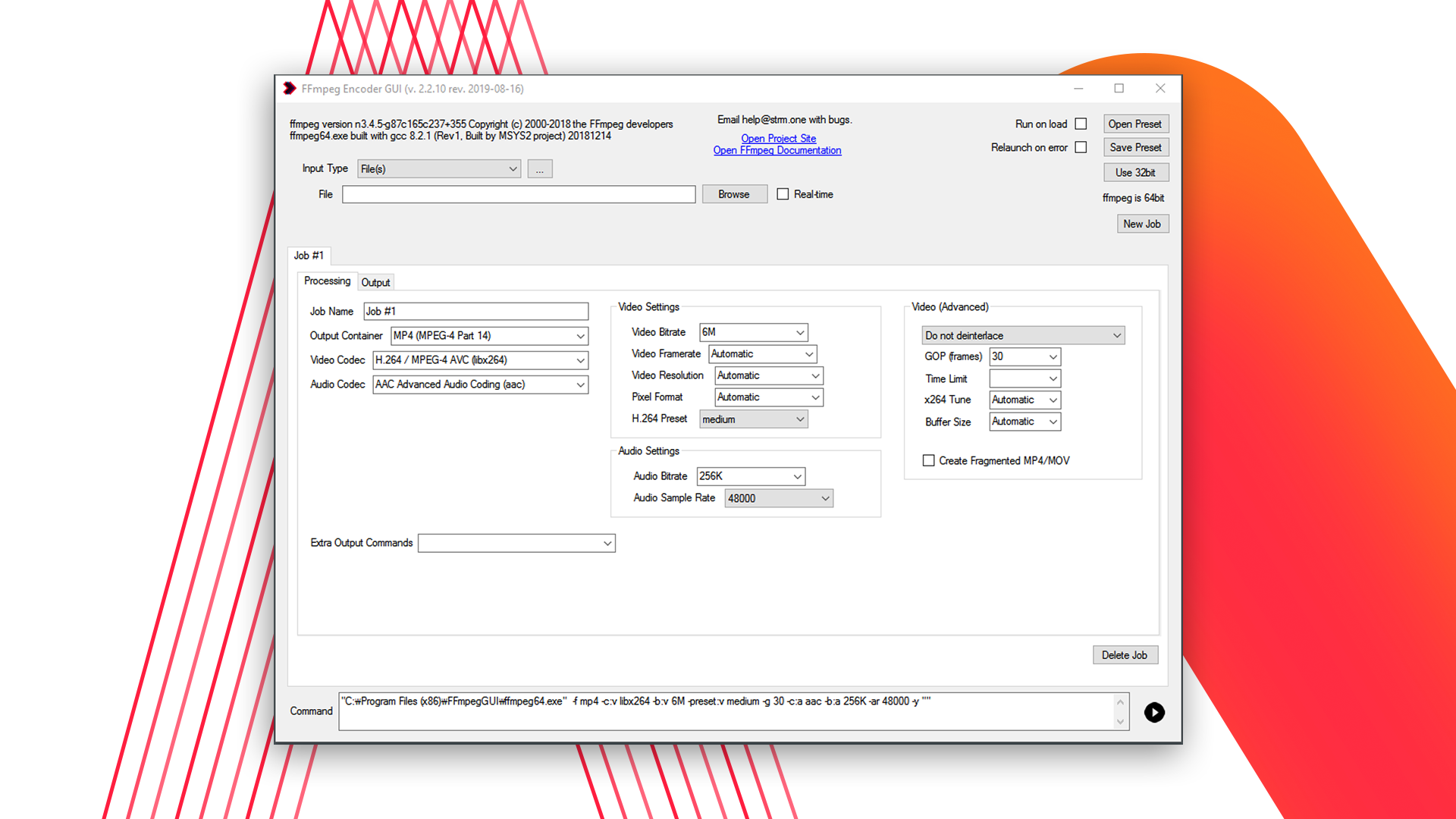
FFmpegGUI currently supports File, DirectShow, Blackmagic Decklink, NewTek NDI or URL inputs.
Drag and drop your file(s) from your system to be processed quickly.
Prompting to rename any input file(s) with non-ASCII filenames to be compatible with command-line processor.
You can easily export your clip(s) to a file, NewTek NDI destination, RTMP server or any other custom output supported by FFmpeg.
The included FFmpeg is built with hardware encoding support for NVENC. GUI support is experimental at this time, feedback is welcome.
32-bit and 64-bit Windows binaries of FFmpeg included. Current binaries are based on version 3.4.5.
Save your encoding settings as file to be recalled later. Settings are formatted as an XML document.
GUI project is developed by ffmpeg fans and distributed for any usage. Non-free codecs in the included FFmpeg build may have further restrictions.
The film opens with a 19-year-old Alice (played by ) reading an erotic book with her sister when the White Rabbit (Andy San Dimas) appears, leading her into "Wonderland" – a seedy reflection of Southern California.
The preservation of releases like Alice from the Cal Vista library presents unique challenges for modern archivists. Because magnetic tape degrades over time (through a process known as binder hydrolysis or "sticky-shed syndrome"), capturing these specific split-scene masters requires meticulous care. The Modern Archival Process Alice -Cal Vista- -Split Scenes-
In the ever-evolving landscape of contemporary digital art and visual storytelling, few motifs carry the weight of —a character synonymous with the blurring of boundaries between the mundane and the surreal. When viewed through the lenses of Cal Vista and Split Scenes , this journey down the rabbit hole transforms from a Victorian fairy tale into a modern meditation on perspective and place. The "Cal Vista" Aesthetic: A Sun-Drenched Limbo The film opens with a 19-year-old Alice (played
Cal Vista was a major player in the adult film industry. According to a preservation wiki, was an American adult film production and distribution company based in California. It had a long and sometimes controversial history. In the early 1990s, the company found itself at the center of federal obscenity cases. A 1990 federal indictment in Tulsa, Oklahoma, charged Cal Vista, Ltd., its president Sidney Niekerk, and vice president Jack Gallagher with shipping obscene movies across state lines. The case was part of a broader federal crackdown on Los Angeles-based pornography producers at the time. This legal history provides a crucial backdrop for understanding the company's notoriety before the 2010 release of Alice . The Modern Archival Process In the ever-evolving landscape
: Collectible tapes are highly sought after by cinephiles for their distinct low-fidelity, warm analog aesthetic.
I will also mention that the "split scenes" technique might refer to the film's narrative structure or a specific visual style. I'll use the available sources to support the article. Now, I'll write the article. is a deep dive into the 2010 adult film Alice , a standalone XXX release from the Cal Vista studio that stands out for its high-concept approach and unique narrative structure. The following sections explore the studio's history, the film's production, its clever use of the "split scenes" technique, and its lasting cult status.